
Squatters and Vagabonds
By Patricia Crisafulli
June 1971
The start of summer vacation meant bursting out of the back door, through fields of high grass and into deep stands of trees with heavy limbs and craggy bark. The Woods, said with reverence that implied capital letters, spread its canopy of native hemlocks, maples, beeches, and oaks. Two-hundred-year-old stone walls did nothing to deter the three children, a sister and two brothers stair-stepped at ages eleven, nine, and seven. They wandered from what had been their great-grandfather’s farm to neighboring land, knowing they would always be forgiven their trespasses.
Sarah, the oldest, wanted to make a map, but Jimmy, in the middle, could not wait so long. He snatched the paper and scattered the colored pencils. His sister gave chase, and the screen door slapped the frame. Johnny, the youngest, plodded behind, whining for them to wait, that he couldn’t keep up, that he’d tell Mom if they left him. Ignoring their little brother, Sarah and Jimmy jostled each other to lead the way, skirting the blackberry thicket and windmilling their arms against clouds of mosquitoes.
Reaching The Woods, they slowed their pace, knowing they were beyond shouting distance from the house, where their mother cleaned the same six rooms every day and from which their father left for work each morning and returned after supper was already on the table. Sarah scanned the loamy ground for wood violets and tiny mushrooms with caps shaped like a hat an elf might wear. Jimmy wielded a stick like a sword, yelling en garde just like he’d heard in a movie once. Johnny dogged their heels, asking where they were going and when they would go home. Jimmy told him to stop being such a baby, Johnny threatened to tell, and Sarah reminded them both that she was in charge.
Only when they’d scoured their part of The Woods did they return. Hot, sweaty and thirsty, they sat on the back steps and drank lemonade from tall glasses with glitter flakes in their plastic sides.
Their father came home from the factory where he worked as a foreman, which meant he wore a short-sleeved shirt with a collar but no tie. “Can’t you kids find something to do?” he asked, climbing the steps they’d just vacated.
“Yes, Dad,” they chorused.
“You can’t just sit around here doing nothing. When I was in the Army, they’d string you up for less.”
Sarah headed toward the garden, Jimmy and Johnny in tow. “Shell shock,” she whispered, repeating the words she’d heard their mother say once.
It was a conversation they hadn’t been meant to overhear, their mother talking to their aunt, something about their father coming back from the Pacific and seeing the enemy behind every tree, even in his own backyard. Their mother was their father’s second wife, they knew, though nobody was supposed to talk about it. She was twelve years younger than he was and spent much of her time cleaning invisible dirt and staying as quiet as possible.
Crouched among the vines in the garden, Jimmy found a tomato that was pink enough to pick. They carried it to the house to ripen on the windowsill, but at the back door they heard their father’s voice, loud and sharp. They left the tomato on the porch railing where it rolled off and got lost in the weeds.

On Saturday morning, Sarah was sitting at the kitchen table eating Rice Krispies when Jimmy came out of the bedroom he shared with Johnny. They exchanged a glance as their father piled a forkful of eggs onto a triangle of toast and put half of it into his mouth. “Sarah, you’re old enough to help around here,” he said, still chewing.
Their mother appeared at the table, coffeepot in hand, to refill his cup. “Oh, they both weeded yesterday.”
Their father made a face. “Seems to me Sarah could do that herself.”
Under the table, Sarah brushed her brother’s leg with her knuckles. “It was hard,” she said. “Some of the weeds—we had to use the shovel. Jimmy did that.”
Chair legs scraped as their father stood. “One of these days, you’re going fishing with me.”
Jimmy pulled his napkin off the table and squeezed it into a tight ball of sweat-dampened paper.
“What do you have to say to that?”
“Yes, sir.” Jimmy said. “Fishing will be real good.” He took the piece of toast his mother offered, spread thick with strawberry jam just the way he liked it.
They stayed around the house until mid-morning, helping a little, but mostly getting under foot. When their mother said they could go out, Sarah asked if they could bring sandwiches. They made three of them: peanut butter and jelly on store-brand bread that never stayed spongey.
Once they reached The Woods, Jimmy headed in a different direction. Sarah grabbed his arm. “Where’re we going?”
“Someplace else.” He pushed on. “I’m tired of where we always go.”
The Woods thinned from the thick growth of old pines. They crossed the remnants of a rail fence, now weathered and splintered, and entered what had once been farm fields and pastures, now filling with scrub bushes and spindly maples. Gravel scratched under their feet, the lingering hints of what had once been a road or maybe a long driveway. It led to a mound of grapevine and Virginia creeper with a brick chimney poking out of it.
“It’s a house,” Sarah breathed.
“Maybe it’s haunted,” Jimmy said, curling his fingers into monster hands.
“I wanna go back,” Johnny whined.
They skirted lilacs gone feral and hedges that swelled in height and girth. At the front they could make out four broken steps leading up past splintered posts of a front porch. They fanned out, the two older children walking toward opposite compass points with Johnny tagging along behind one, then the other.
“Look!” Jimmy yelled, and Sarah came running.
There, with sumac growing right out of its middle, rested an old car. They snatched at the berry bushes and vines that enveloped the doors and hid most of the roofless interior. Rusty springs sprouted from rotted upholstery, and every bit of glass was gone. But there was a steering wheel, and the children squeezed into the front, jostling for a turn in the driver’s seat. Then they ate their sandwiches right there as if they’d made a rest stop along the road.
Every day they gobbled breakfast, raced through their chores, plucked weeds out of two rows in the garden, slapped together peanut butter sandwiches, and promised to be back by dinner. No more wandering; they had a destination, which they reached before the sun stood directly overhead. Jimmy carried an knapsack, refusing to say what was inside, until they reached the old house where he produced a pair of garden clippers. They fought over who got to use them, but after twenty minutes of chopping away vines, Jimmy relinquished them to Sarah. They cleared the front, gingerly climbed the steps, and shouldered open the front door, letting out the acrid stench of rot and mouse droppings.
“Dare you to go inside,” Jimmy said, pushing Sarah a half-step forward.
She crossed the threshold into what had once been a parlor, the floral wallpaper faded into faint stabs of color. Jimmy followed close behind, Johnny hanging on to the bottom of his T-shirt. Something scrabbled overhead, and they reversed course.
Beyond the house, they found a pile of boards, a broken window, and two bald tires. Jimmy wanted to bring one of them home for a tire swing, but Sarah argued that their father would ask where they got it. “Just tell him we found it,” Jimmy said.
A twig snapped behind them. Sarah turned first, her widening eyes telegraphing trouble. Jimmy gripped Johnny’s arm and pulled him back.
The woman wore a long, faded granny dress; her shoulder-length brown hair was mussed and matted. The man in jeans and a stained shirt scratched at his full beard.
“Hippies,” Jimmy whispered. These were people their father had warned them about in the same tone of voice he used for Communists.
Sarah held out the paper sack, the top bunched from being carried in sweaty hands. “We have sandwiches.”
The woman came closer. “Thank you.” She smiled, showing crooked teeth.
The three children sat on the ground, watching the two adults eat as if they hadn’t had a meal in a long time.
“I’m hungry,” Johnny complained, and Sarah told him to shush.
The woman pushed her hair out of her eyes. “You live around here?”
Sarah said yes and Jimmy said no, their answers colliding.
The man huffed out a laugh. “Well, close enough. You know who owns this land?”
The children shook their heads.
“You gonna tell if we camp here a while?”
They shook their heads more vigorously.
Then Sarah scuffed her Keds against the ground and rose to her feet. “We gotta go now. Our mother wants us to do something.”
“See ya,” Jimmy said and grabbed Johnny by the hand.
They said nothing until they reached the stone wall and reentered familiar land. “They were squatters,” Jimmy said.
“What’s a squatter?” Johnny asked, crouching on the ground as if his body now defined the word.
“Somebody that lives where they shouldn’t,” Jimmy said.
“No, they’re like—vagabonds.” Sarah savored one of the big words she liked finding in books.
Two days later, they sat outside, debating where they should go. They hadn’t told their parents about what they’d seen and who they’d met, knowing that would only lead to their mother’s worry and their father’s lecture or worse.
“They seemed nice,” Sarah said. “They said they were just camping.”
Jimmy made a face. “Dad would skin us if he found out.”
Johnny picked a small stone out of the ground and tossed it into the grass. “I wanna play with the car.”
It was decided, and they made five sandwiches instead of three when their mother wasn’t looking and added a handful of Oreos.
They headed straight for the house and searched the overgrown yard for signs of the couple. “We can leave their sandwiches in case they come back,” Sarah said.
So, they left soggy peanut butter and Jelly and three Oreos in a paper bag in front of the house. They sat in the old car, which after several days had lost its attraction. Johnny climbed out first, wandering through the tall grass, singing to himself. Sarah and Jimmy stayed in the front seat, their hands off the wheel.
“I don’t want to go fishing,” Jimmy said.
Sarah looked at him, squinting her confusion, until she said, “Oh, Dad. Maybe it won’t be bad.”
“I don’t want to kill things,” Jimmy said.
“You eat chicken. And hamburger,” Sarah replied.
“That’s different. Comes from a store. I don’t think about it.”
“They’re just fish. It’s not like—”
A piercing scream cut through the air.
They ran toward the sound, finding Johnny on the ground. Blood spurted out of his thigh, coating the bottom of his shorts and running down the side of his calf to his socks now rimmed in red.
“What d’you do?” Jimmy yelled.
Sarah pointed to a spike coming out of the ground. “He must have fallen on that.” She tried to pick up Johnny, but he writhed and she dropped him.
Just then, long arms reached for Johnny, scooping him up from the ground. The man held him while the woman took a bandanna out of her hair and tied it around the boy’s leg, just above the wound.
“Let’s go,” the man said.
Sarah and Jimmy headed the way they’d come, but the man started in the other direction. “This way.”
A half hour later, standing on the shoulder of a country road, Jimmy waved his arms at a car that sped past without a flicker of brake lights. Sarah took off down the pavement, saying she’d find a house someplace. Before long, she returned in the front seat of a car driven by a woman with two children in the back.
The driver’s eyes widened. “Now look here, I don’t have room for all of you,” she sputtered.
The man holding Johnny loaded the boy onto Sarah’s lap. “You kids’ll be all right.”
The woman reached around, touched Johnny’s cheek. “Be brave little man.”
Present Day
Jonathan poured white wine from the vineyard he had just bought, an indulgence paid for with stock options from the tech company he co-founded. “I still have the scar.”
Sarah held up her glass, admiring the hint of peach within the golden liquid. “With your money you could get it removed.”
“And lose my badge of honor from childhood?” Jonathan smirked.
James cast a glance across the expansive deck that wrapped around two-thirds Jonathan’s house, which could easily be called an estate. His partner was engrossed in conversation with Sarah’s husband. “What surprises me is that we never told. Not a word to the police. Not mom, certainly not dad.”
“He would have gone into those woods with a flamethrower.” Sarah exaggerated a shudder. “We never went back to that old house. Never thanked them for what they did.”
Jonathan took a deep sip of the wine. “Did I ever show you the new label?”
Sarah smiled, glad they could all be together for the launch of Johnny’s vineyard. Although scattered across the country, they made an effort to stay connected.
“Let me guess—the label is a self-portrait,” James teased.
Jonathan reached for a portfolio and laid several designs across the table. A profusion of vines coiled out to the edge of the label. In the center was a black-and-white sketch: a rundown house, a chimney poking out of the overgrowth, and in the trees a hippie version of Adam and Eve half hidden by the foliage. The script read Vagabond Vineyards.
“You named this place for them?” Sarah said.
James clapped his brother on the shoulder. “You’re not half the jerk I thought you’d grow up to be.”
Jonathan raised his glass in salute. “Squatter Vineyards didn’t have as nice a ring.”
Sarah drew the sketch closer, comparing the drawing of the man and woman with how she remembered them. Close, she decided. Yes, it was very close.
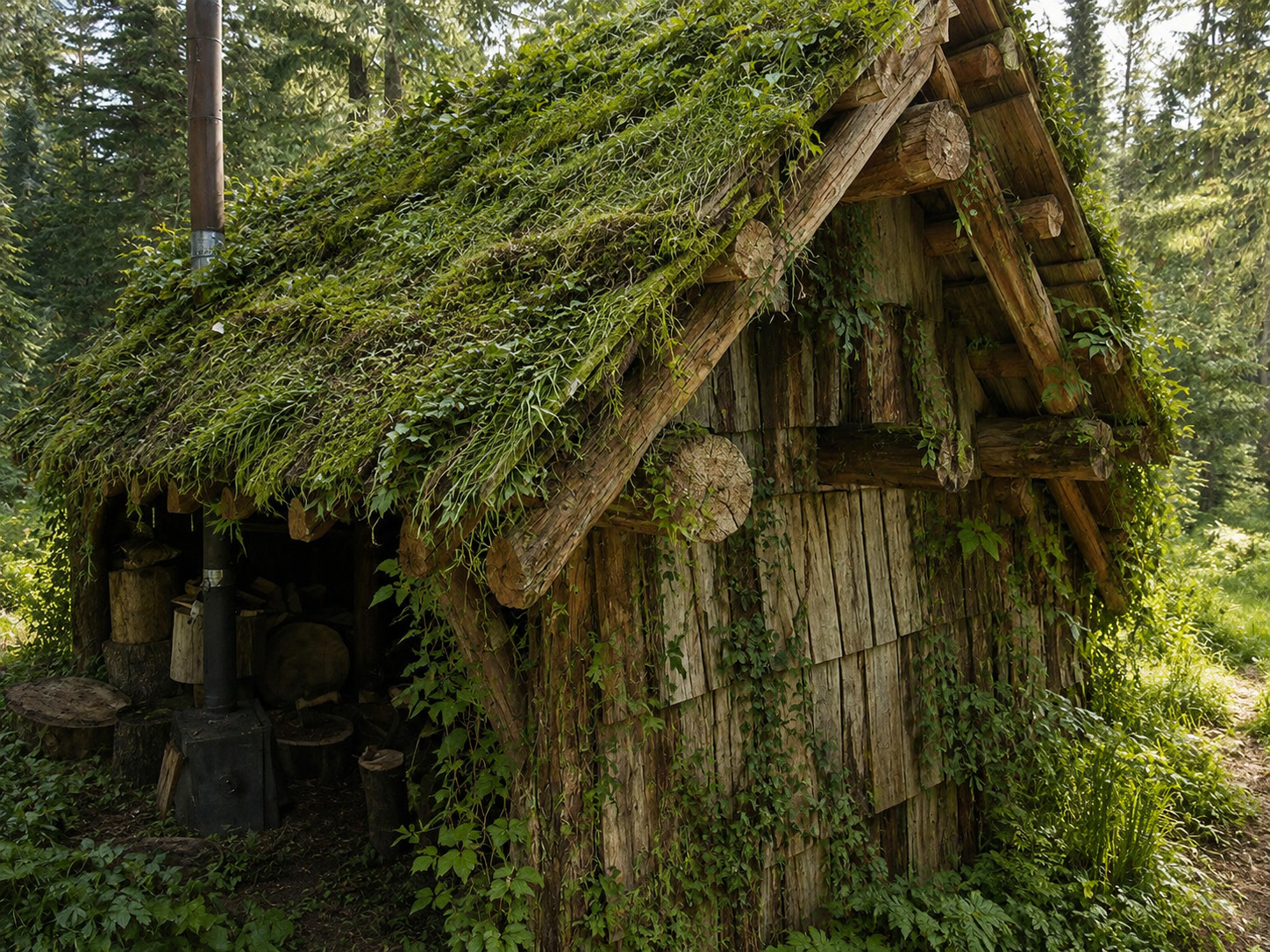
Author’s note: The photo originally depicted a warm-up shanty for skiers, enhanced with AI to look like it was covered with vegetation.