

A Dogeared Christmas Transformation
By Adrian Rosenfeldt
Rachel had already decided that this Christmas she would stay home, work on her novel and look after the dog – and none of that was up for negotiation. No one seemed to realise that getting a book published was about as likely as winning the lottery. She had done it once but that didn’t mean that it would automatically happen again.
But her father would not let it go. And he was using his annoying slightly sarcastic cajoling tone with her.
“So, I’ve heard from your mother that you would rather not come away with us at Christmas. That you would rather stay here and brood by yourself?”
Rachel straightened up in her chair but didn’t look up from her phone. It was way too early for this. He had been up for hours – she could tell. He was literally vibrating with energy. It was sickening.
“I’m going to look after Hugo. You’ll save a lot of money. And I don’t believe in Christmas or Seasons Greetings – the whole thing is just pointless.”
She thought of the Bourke Street Mall at this time of year – Melbourne at its worst: frivolous, festooned, frantic.
“Pointless?” her father spat back. “A lot of people seem to think otherwise. Don’t you think you are being overly intense about this? It’s just a holiday, Rachel. A time to reconnect with …”
“It’s not complicated. I simply don’t believe in your holidays. They’ve all been mandated by the government. For no other reason than to keep everyone docile and compliant. They’re all ridiculous and offensive.”
“Offensive? All of them?”
“Every one of them. Australia Day – invasion day. Valentine’s Day – patriarchal day. Easter, Grand Final Day, the Melbourne Cup – fairytales, men being brutish and torturing horses.”
“They really need to hire you to sell Australia to the Americans. Who could resist!”
“And let’s keep the colonial spirit alive with Anzac Day. And Christmas Day – more fairytales and capitalist consumerism – selling trinkets to keep the masses occupied.”
“Spoken like a true Marxist.”
“Better that than still believing in all this fairytale propaganda. It’s embarrassing that you still go to church.”

From her bedroom window, Rachel watched the two familiar figures slowly get into the car. She sat on her bed and let out a deep sigh. They always took forever to leave, making all sorts of announcements, and then faffing about for an eternity. Rachel knew she could not get settled into her writing until they had shut that front door.
She pulled a notepad towards herself and started neatly writing the other things that she would do today, on the 24th of December – she made a point of not writing Christmas Eve.
As Rachel wrote her list, she found herself thinking: Unlike everyone else, when I write something down it actually gets done. It is not a wish list, a fairytale, it’s reality!
- 6 hours writing
- walk Hugo
- go to the shops
- swim 50 laps
- eat dinner
- bed
Ticking off the first thing on her list, she worked on the latest chapter of her book in two three-hour blocks. This was the way to do it. No distractions.
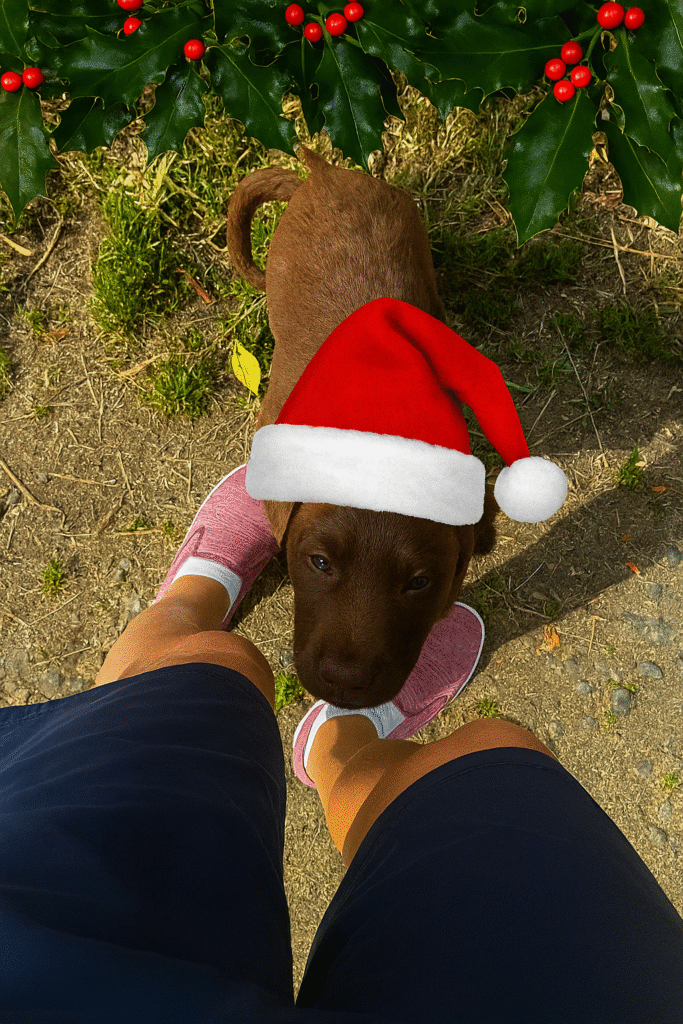
But then it took her ages to get Hugo’s harness on, as he lay stubbornly on the floor refusing to budge. She nearly gave up. No one would notice. He couldn’t say otherwise.
“Hello Hugo!”
Rachel stopped and gave the man a hint of a smile. She was embarrassed to be seen outdoors with her parents’ dog. If only people could walk cats. Dogs were indiscriminate – sniffing everything, dragging you into pointless interactions with strangers, forcing small talk where none was wanted.
“Rachel, is it? Has your mother given you the dog-walking duties?”
“They’ve gone away,” she replied. A statement of fact, shorn of warmth and possibility.
Predictably, the man launched into a stream of genial nothingness. Rachel held eye contact while filtering out every word. She focused instead on regretting her choice of loose-fitting black jeans and Celibate Rifles t-shirt from the Vic Market – clothing chosen for people who notice. But here? No one noticed. No one ever noticed.
She leaned over to tie Hugo’s lead to a bike stand. He looked up at her in anxious bewilderment, still wagging his tail. She resented how dependent he was, how utterly at the mercy of others. She could never bear such helplessness. Hugo’s warm breath reached her fingers and she jerked away, rising quickly to escape it.
The health food shop was shut, so she reluctantly went to the supermarket. She didn’t blame the couple who ran the Radical Radish – she wouldn’t work on Christmas Eve either, even as an ironic gesture. Still, Rachel thought that by shutting their doors, they were letting Christmas win. With nowhere else to go, she braced herself and stepped into Woolworths.
It couldn’t have been any worse. Rachel darted around the aisles, guarding her eyes from the Christmas pap. She was still recovering from being blasted with chemically manufactured mist at the entrance. For a moment, she theatrically staggered about as if she was having a medical emergency, hunched over, coughing emphatically. No one blinked an eyelid. They were all too far gone.
“Do you need a receipt?”
The one cool guy working in this hellhole was giving her direct eye contact. She had been singled out.
She desperately wanted the receipt – she liked to keep track of everything, but didn’t want him to know that.
“Nah, it’s cool,” she said, lifting the bag slightly so he could see her Celibate Rifles T-shirt. He had already turned to the next customer.
“Happy Christmas!” he chirped at a middle-aged woman with a trolley stacked with Coke, frozen pastries, Tim Tams and instant dumplings. The chirpiness of his voice and the sight of the trolley’s contents made Rachel feel ill. He seemed quite happy as he helped her unload a self-harm buffet for the whole family.
What was wrong with everyone? What was wrong with her? Rachel fumed silently. The checkout guy gave no indication that he had found her alluring, or mysterious. Why did she always think that they would see her secret self. That they would get it and that there would be some signal. A knowing look.
The pool was all but empty. Rachel felt an immense sense of calm and gratitude. She loved being in warm water, her body slipping away. The more laps she swam, the more she felt herself disappearing into the water. Her breaststroke barely disturbed the surface. Sometimes she forgot where she was entirely and counted laps like a meditation.
Not today. A middle-aged man swam in the lane beside her. No matter which lane she chose, men like this always found the neighbouring one, even in an empty pool.
“Good day for it,” he shouted, oblivious to his waterlogged earplugs. “Nice to get a few laps in before the Christmas feast.”
She ignored him. These men were so unaware of themselves, always taking up space. They never swam quietly. They snorted at the end of every lap, gulped air dramatically, grunted, gasped, made their existence unmistakable. Women glided. Men spilt themselves all over the place.
Slap. Slap. Slap.
The spray hit her face. She held her breath and craned her neck in the opposite direction.
When he approached, she pushed off the wall with force, gliding away like a swan escaping the shore. Anything to be distant from that graceless figure thrashing through her silence.
Hugo wouldn’t even let her hang her wet towel on the line when she returned. He stomped on her feet, grovelled and whined. He wanted to be fed. Pathetic. That’s all he thinks about. The entire course of evolution has been lost on him. What was that line from Shakespeare? What is a man, if his chief good and market of his time be but to sleep and feed? A beast, no more.
She thought of a witty reply: “That is a man and his dog. Now let me show you a woman and her cat!”
Rachel threw the food in his slobbering bowl, trying not to touch the edges. Her mother had made her promise that she would give Hugo an extra treat on Christmas Eve and on Christmas Day. She had left detailed instructions. What a joke. Hugo knew as much about Christmas as he did about the food he indiscriminately swallowed whenever he got the chance.
She wasn’t going to eat any of their festive junk. She would drink tea and work on her chapter. A whole day without giving in to the capitalist pageant.
The tea from their Chinese neighbours came in a little linen sachet. It took her considerable time to loosen the tiny piece of thread so that she could pour the tea leaves into the old, chipped teapot that her parents had had forever – they never bought anything new unless it broke or vanished.
She considered taking the pot upstairs to avoid Hugo’s farting, snoring and general dogginess. But better to try it here first in case she disliked it. Otherwise, she would have to descend the stairs again and endure more barking.
It tasted faintly of liquorice. Warm, calming. She drank deeply and felt herself soften. Her eyelids grew heavy. Much against her own wishes, she drifted off on the couch beside Hugo.
The smell hit her first – sweat, fur and dank couch. Hunger followed, sharp and urgent. Her yearning felt raw, unfiltered.
She heard the front door slam. Someone had left or arrived. She raced up the stairs and stared out the window.
There were her parents, lifting a suitcase into the boot of the car, repeating the exact movements that she’d seen the day before. A rush of joy flooded her, followed immediately by panic. She wanted to run to them. But her legs would not move properly. Her balance was wrong.
She looked down.
Where her hands should have been, she saw Hugo’s paws … and she felt extremely hot and … furry! And unclean!
She didn’t believe it. She refused to believe it.
The room tilted sideways. Footsteps approached on the stairs. She turned.
Rachel was descending toward her. Her own body, her own mannerisms, her own guarded face.
She tried to speak. A bark burst out of her. Then another. Then another.
“Put a lid on it, Hugo,” the woman snapped. “They’ve only been gone a few minutes and you are losing your little mind.”
She followed the woman into the kitchen, heart surging with hope and hunger. The cupboard opened. The smell of food flooded her.
“It’s too early,” the woman said. “Back to the couch.”
She wagged her tail and backed away in confusion. What followed was a blur of sensation. She felt everything through the body of a dog. Hunger came in waves. Time slowed. The woman moved through the house as a presence she adored and feared. Every glance, every withheld touch, mattered.
She wasn’t allowed to bark or to whine, so all she could do was to stare imploringly. Her eyeballs ached from trying to get some attention, but all she experienced was hostility and rejection. It was devastating.
By evening she could barely keep her eyes open. The woman finally sat on the couch. She crept close panting – she couldn’t help it. A hand pushed her away. “You smell awful.”
She curled up quietly at the opposite end of the couch. And even though that incomprehensible presence was still beaming hostility, she felt a glow of reassurance and warmth, just knowing that they were both there on the couch together.
In the body of Hugo, she was so content that she did not even perk up when the smell of liquorice invaded her wet nostrils.
Rachel woke with her mind swimming, as if she’d surfaced from a deep well of sleep. She saw daylight edging around the blinds. And then she saw Hugo – the real Hugo – stretched out at the other end of the couch. She looked down at her own familiar hands, pale and human again. Relief washed through her.
“What a monster I was,” she said. Then more softly: “What a monster I am.”
Hugo gazed at her with wide, waiting eyes. She recognised the look instantly. Without thinking, she pulled him into her arms and held him tightly, until he wriggled away and padded to his bowl.
This was Christmas Day – unfolding like none before it.
Rachel called her parents and wished them a Happy Christmas. At first they didn’t believe it. But she heard the warmth in their voices, the relief, the softness.
She ate breakfast on the couch with Hugo, careful to give him every treat her mother had set aside.
Afterwards she walked to her parents’ church and slipped inside. People were surprised to see her, but they welcomed her with open smiles. She explained she was staying home to look after Hugo, so that her parents could go and visit her sister. After the service she found herself pouring tea in the church kitchen, chatting easily, laughing at small things.
In the afternoon she weeded the front garden. When passersby stopped to talk, she looked up and spoke to them. One elderly couple said they knew Hugo, and she smiled back with something like genuine pleasure.
As the day grew dark Rachel felt a familiar stirring and wanted to retreat upstairs to her room. She became aware once again of Hugo’s smell and wanted to be on her own. But when she looked into those eyes Rachel felt that same wave of emotion that had come upon during that – what would she call it? – that transformation.
Rachel stayed on the couch all night with a smelly dog on her lap. She watched some lowbrow Christmas comedy on a commercial station her parents loved. She found it delightful. What was happening to her? Or rather, what had happened to her?
No time to think about that now. She did not want to disturb Hugo.
Dr Adrian Rosenfeldt is a writer and academic based in Melbourne, Australia. He teaches at the University of Melbourne and has written widely on culture, spirituality, and contemporary society. Adrian writes articles and hosts podcast conversations exploring spirituality and contemporary cultural life. His work is available at https://about.me/arosenfeldt
Adrian is also the author of the book, The God Debaters (2022).