

The Necklace
By Patricia Crisafulli
For forty-six years, she could not explain how the little wooden figure had gotten into her pocket. Only six at the time, she’d denied taking it, first with words and then with tears. Finally, in what would become a seminal moment, she realized it was better to stop asserting her innocence and take the humiliation of handing the toy and the apology note from her mother to her first-grade teacher. Then came the punishment of being reminded, again and again, that no one likes a liar and a thief.
Sara stirred her coffee, watching the dark turn to light as cream met the brew, and recalled the certainty she felt four-and-a-half decades ago. She had not taken that little wooden man with a pointed cap and a pointy nose and jointed arms and legs. That little Pinocchio had simply appeared in her pocket. All day, she saw another child playing with it, openly at recess and then secretly as they listened to their teacher read aloud and learned that one plus two equal three. At the end of the day, the boy had cast a glance around the room, their eyes meeting, and he smiled. She could see it still—a curling sneer that revealed a missing baby tooth.
She saw him put the toy in his pocket. A little while later, she felt a lump in her corduroy jumper.
Such things—Sara never gave them a name—did not happen often; years could go by between these incidents. But each was inapplicable. At nineteen, she had watched through the wide plate glass windows of a drugstore as the manager chased a shoplifter into the parking lot. Turning away from the scene, she felt her purse getting heavier and, opening it, found jewelry and makeup that she managed to empty into a shopping basket while everyone was distracted by the shouting match outside.
And once, leaving a restaurant, she reached into her pocket for her gloves and pulled out an extra pair—these leather and lined in cashmere. She slipped them on, just for one luxurious moment, then brought them back to the coat check. “They’re not mine,” she told the attendant and put on her own knitted gloves with the tiny hole in the thumb.
Unconscious kleptomania. That’s what the therapist she saw during college had called it, an opinion pronounced like a diagnosis. Some compulsion made her want to take small things, just for the thrill of it. Then shame blocked out the memory of having done so. The root cause was clear, the therapist had said, almost excitedly. “You keep repeating that childhood incident, hoping that this time someone will believe you.”
Sara had pushed back at first; she’d never taken anything in her life. The therapist looked at her with clinical coolness and only a hint of compassion. And so, she’d nodded—yes, yes, it seemed logical, made sense. Two more appointments, just to be polite, then no more therapy. She affirmed what she had learned at six: no one would ever believe her.

The litmus test was during a trip to New York, twenty years ago, when she and Bill had been married three years, and he’d taken her into Tiffany’s just for fun. Amid displays of diamonds the size of dimes and gemstones in every color and facet, she’d jammed her hands into her pockets. Over and over, she pounded the drumbeat of an admonishment: These things do not belong to me. They are not mine.
Bill mistook her tense expression for disappointment and bought her the only thing he could afford: a small silver keychain. Every year since then, there was an aqua-colored box from him for her birthday. He always looked so pleased, and she loved him for it, unable to tell him that these gifts carried a secret reminder of her shame.
For twenty years, nothing turned up in her pocket. Twenty years without something to return or slip back onto a shelf. Twenty years without doubting her own character, her sanity.
Until a half hour ago.
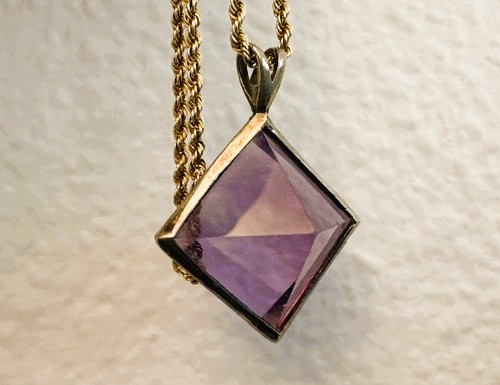
Home from her job as a dental hygienist, Sara had been chopping vegetables for ratatouille when Marcia called, her voice rasped with tears: Her great-grandmother’s amethyst pendant was gone. Sara knew it well, had seen her friend wear it dozens of times: a round, faceted stone the size of a quarter set with filigree on a serpentine chain.
“I wore it yesterday,” Marcia pleaded. “When I got home, I took it off and put it in the velvet box. I know I did.”
Sara listened, relief pushing aside sympathy; she had not been anywhere near Marcia’s house in more than a week. “I’ll come over and help you look,” Sara promised. “Be there soon.”
As she put diced eggplant and zucchini into glass containers with lids, Sara felt something. The kitchen stool rocked into the counter as she slumped onto it. Wrapping her hands in the striped fabric of her apron, she willed whatever was in the pocket to go back to the velvet box or disappear into the ether with all lost things.
The patio door slid open and Bill came in, cellphone to his ear, a grin and an eyeroll at how long his call had dragged on. The furrows between his brows deepened as he looked at her, and Sara heard him hurry the conversation to a conclusion.
“What’s wrong?” he asked.
Sara’s fought brimming tears. “I have to tell you something.”
His face became a kaleidoscope of emotions: fear to worry to doubt to concern to anger and back to fear. “I know this sounds crazy,” Sara said for the fourth time. “It is so much easier to assume I’m some kind of thief.”
Sitting on a kitchen stool facing her, Bill tapped his toes in rapid succession. “We have got to give it back,” he said.
We, not you. Sara registered the words. Her husband, the forensic accountant who found the errors and corrected them, was going to help her.
As Bill drove, Sara faced the window, the neighborhood blurring past them. She thought back to their early days as a couple, when his mother had not approved of her. It had less to do with her, Sara knew even then, and far more with the fact Bill had just ended a long relationship with a woman his parents had loved—the daughter of their best friends, a match wished for since childhood.
Then suddenly, soon after Sara had met Bill a coffee shop, it was over. The woman his parents had expected to be their daughter-in-law was replaced by a stranger. For years, long after they’d married and their children had been born, Sara felt judgment from Bill’s mother that she had stolen him.
Now, twenty-three years and two college-aged children later, given what she’d just told him, would Bill still defend her? Would he choose this life with her?
No, she told herself. From now on, every time they went out together—to every store, market, restaurant, museum—he would be watching her, probably reminding her to check her bag, check her pockets. He’d treat her like an unrepentant thief.
Bill swore under his breath, and Sara turned first to him and then toward the windshield. Up ahead, on the left, she could see Marcia’s house with a police cruiser in the driveway.
“You think we should just go back home?” Sara asked.
Bill shook his head. “We’re here. You said you were coming. We better go in.”
Marcia’s husband, Jim, opened the door, thanked them for coming, and led them inside, His words formed a staccato explanation. “Back door forced open. My Rolex … Marcia’s jewelry … A laptop out of my office.”
“So, not just the pendant,” Bill said. “That’s what Marcia told Sara.”
Jim shrugged. “That’s what she saw at first. The empty box on the dresser. Then we noticed what else was taken.”
A police officer entered the room, his radio crackling. Marcia followed, wiping her tears Sara hugged her friend, and Marcia’s arms tightened as she sobbed. “Someone came in my home. I don’t know if I’ll ever feel safe here again.”
At the kitchen table, Bill and Sara sat with Marcia while Jim went with the policeman out into the yard to take another look. As Marcia related everything—coming home, seeing the empty box, calling Jim, searching the house—Sara rubbed her hand along her own thigh under the table. She couldn’t keep her hand still, feeling the shape of the pendant, the coil of the chain in her jeans pocket.
Then, suddenly, nothing except the smooth fabric. Sara’s eyes widened in Bill’s direction, but he only gave her a steady look. It’s gone, she mouthed when Marcia turned away from them and toward the tissue box.
A few minutes later, the door flung open and Jim rushed inside. “We found it!” Backlit by the sun, what Jim held was hard to see, but Sara knew.
“Under the hedges,” the policeman said, stepping into the kitchen behind Jim. “Strange place for somebody to drop it, but that’s where it was.”
Bill looked at Sara, his gaze telegraphing what he knew: they had been together the whole time. Sara could not have put that pendant in the yard; it had simply appeared there.
“What about the watch and the laptop?” Bill asked.
Jim waved his hand in dismissal. “Don’t care. Marcia’s pendant is priceless. Not that it’s worth a fortune. It just can’t be replaced. Her great-grandmother wore it on her wedding day.”
They stayed a little while, long enough to see Marcia’s devastation transform into gratitude. Leaving the house, Bill and Sara walked in silence to their car parked at the curb. Once inside, doors shut and engine on, Bill finally spoke. “I figured it out. You’re a retriever.”
“What? Like a dog?” Sara teased.
“I’m serious,” Bill said, reaching for her hand. “You don’t take things. You retrieve what’s been taken. Like that kid with the toy. The shoplifter. The gloves in your pocket. Marcia’s pendant was stolen, and you brought it back.”
Sara shook her head. “Never saw it that way. I had a secret I couldn’t explain, not even to myself. I’m not sure I can now.”
Bill put the car in gear. “I think you retrieved me, too. And I’ve never stopped being grateful.”