

Rambling a Country Road
By Patricia Crisafulli
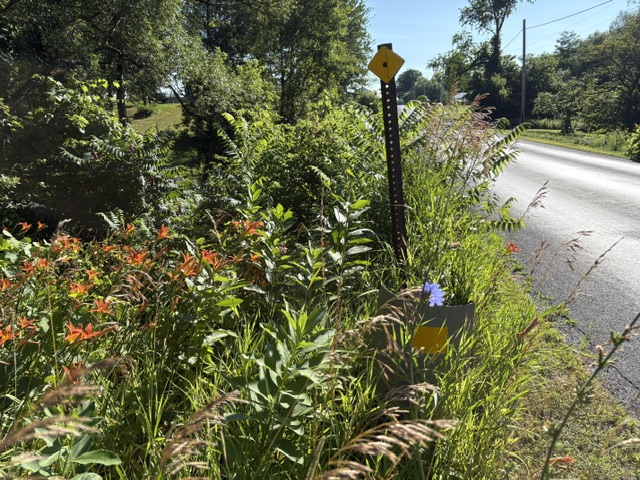
The side of the road blooms with a garden gone wild: the dusty rose cones of staghorn sumac, blue starbursts of bachelor buttons, delicate snowflakes of Queen Anne’s lace, orange trumpets of tiger lilies. A wet spring has burgeoned a profusion as thick as the trees rooted just a few feet from thick-stemmed weeds and hummocks of grass edging the pavement. Green encroaches everywhere.
There is no wide shoulder for walking, no designated bike lane, nor is there much need for one. I am solitary along this country road in the early morning. The few cars that pass me pull to the middle of the otherwise empty lanes, stirring gusts of wind with their speed. In an instant the air stills again to a light summer breeze. Overhead, a redwing blackbird issues a territorial warning from atop wooden power poles. It squats and squawks. I move on, and so does the bird, a pursuit that lasts a quarter mile or so.
My route—mostly jogged, sometimes walked—stretches for miles along a loop that takes me from my cousin Melanie’s home, where I have been visiting for a few days, past houses spaced widely apart, farms with silos and barns of bright red or weathered gray, and wide fields shorn of hay or fluttering green with corn not yet tasseled. This scene is a childhood memory come back to life, of summer days spent bicycling or walking with only two rules to heed: stay out of the way of cars and be home before dinner.

“and all the birds who went away
are comin’ home again,
back to old lofts and barns they knew.”
– Edna Jaques, “Winds of April”
Country roads are imprinted on me. Their rise and fall, twists and turns tug at something deep within me. Nostalgia, reminiscence, fondness—each of these words occupies a corner of the sensation, but not the whole of it. I consider the terms unspoiled and unchanged but quickly reject them because this country road is no throwback to some archetypical simpler time. Cows and horses still graze here, but many of the pastures have subdivided into building lots for two-story homes with detached garages.
I pause to look over the edge of a twisted metal guardrail where the road bridges a narrow stream. Cattails wave their fuzzy brown batons in the air, and marsh grasses dip long slender blades from embankment to rippling current. That’s when I realize how and where I feel the greatest pull. It is from the road itself, a strip of dark gray that undulates through the landscape. All I want to do is follow it.
Make no mistake, these curves hold an edginess, as I learned in childhood seeing roadkill animals and the occasional pet. I recalled that sadness just the other day when I glimpsed the tiny body of a fawn, spots on its back, lying in the tall grass along a road where someone was driving too fast to stop. These casualties speak of a harsh reality that keeps my thinking from straying too far into romantic territory.
And yet, threaded through the hardness is quintessential natural beauty. Like that monarch butterfly bouncing to a bunch of hot pink phlox flowers, no doubt the descendants of some long-ago garden. The farmhouse is gone, as is the gardener, but the flowers keep up their cycle of blooming and seeding. They remember their roots—literally. And so do I.
As I keep jogging, I slip into a kind of time travel, the emotional bilocation of now and then. I am here, with all six decades of my life. But I am also the 12-year-old on a hand-me-down bicycle, riding along country lanes about 30 miles away from where I am now jogging—a young girl with only her imagination for company.
To the west of the house I grew up in was town, where I rode my bike through the grounds of a Revolutionary War-era fort, completely unaware of the novelty of such a landmark. Ditto the local library, built in 1855 to resemble a castle. I thought everybody’s hometown had places like that. Other than my missions of checking out and returning books, I had no real business in town. It was just a place to wander out and back, four miles each way.
To the east and north, though, were the country roads, with tall hills that defeated my young legs until I built the strength and confidence to crest them by pedal power alone. Unleashed dogs charged my bicycle, terrifying me. Blinking back tears, I yelled “Call your dog!”—my voice rising to a scream. No one did, but eventually the dogs gave up. Fortunately, I didn’t and kept riding through the places I dreaded to reach the ones that delighted me.
Oh, what a metaphor it seems to me now: the quest, the dogs as gatekeepers, the challenge of facing fears and doing hard things. The need to prove myself, to myself started early.
The payoffs were the destinations where I could see my future: farmhouses, neither large nor grand, but beautiful to my young eyes.
There was the white one with a wide porch and curlicue gingerbread woodwork along the pillars and tidy gardens bordering its steps. Beside it stood a graying barn, large enough for a full hayloft to feed the animals. Cows and horses and chickens and sheep were fine in theory—something besides me had to live on the farm in my imagination. But they were never the attraction. It was the house: lacy curtains downstairs and ruffled priscillas framing the upstairs windows, a rocker at one end of the porch and a swing on the other.
I realize now that I longed for the feeling this house gave me, for the simple fact that it was old and more suited for my girlish notions than the modern brick ranch with the stone front and the paved driveway that my father had built six years before I was born. The house I grew up in belonged to my mother, furnished in her pride for housework and gardening—and also place of too much arguing and hurt feelings I learned to swallow.
Then there was the stone farmhouse along a different road, discovered on a bicycle ride when I was about 13. Yellow and orange daylilies brightened the yard deeply shadowed by tall trees. Down a long driveway stood a barn and beyond it fields that no longer pastured animals, becoming overgrown by scrub bushes and saplings. It seemed magical to me, as if a place where dreams could come true. And I knew what mine was, the first inkling awakened when I was seven and then full-fledged ambition by age 12. I would be an author.
Right there, in that little upstairs window of the stone farmhouse, I would sit at night and write by lamplight. The scene clarified each time I passed by. This was my future home, the place where I would grow up and pursue the plans that never felt safe to share with anyone. Not at 13, not as the youngest in a family in which standing out was a liability.
Once I saw an old woman in a faded dress puttering among the flowers in front of what I considered my stone house. She looked up and smiled and I grinned back, a spark of mutual recognition among kindred spirits. It was a sign. This old farmhouse filled with lovely, curious things would be my home where I would nurture myself like the flowers in the garden.
And I would be wrong.
My first move took me from my hometown to a daily newspaper job in a city of about 40,000 people. From there, I moved to New York City, working as a journalist and walking city streets to and from a skyscraper each day. Next, I went to Chicago and settled in the suburbs, where houses boasted landscaped yards, but not the wild tangle of a country garden.
I live in Oregon now, along a street in a subdivision atop a butte that borders hundreds of acres of woods. There are foxes and coyotes, deer and bear—the occasional cougar, I’m told, though fortunately I’ve never seen one. I listen to the owls at night and the songbirds during the day. But my house is new and my neighbors are close. My husband and I, two cats, and three small gardens hardly constitute a farm. And so, even from my current home, I have to escape to remember.
“All good things are wild and free.”
– from “Walking” by Henry David Thoreau
On this particular morning, visiting my cousin back in New York State, I simply have to excuse myself for an hour or so, down the quiet village street in front of her house to the country road less than a mile away. Oh, it’s pretty here with gardens and butterflies, birds and the occasional deer, like the one that just loped across the pavement in front of me. But it’s not the external landscape that I seek. I’m immersed in my inner world, receded but not erased, the feeling of freedom and possibility I once claimed for myself.
And perhaps, at last, I have reached my true destination. What I longed for all those years ago and along those country roads has always existed within me. I never lost it on those noisy New York City streets, nor did it suffocate in the suburban tidiness.
It’s here, in my veins. It is the imprint of a country road and the rambling that takes me inward, deeper into my dreams.